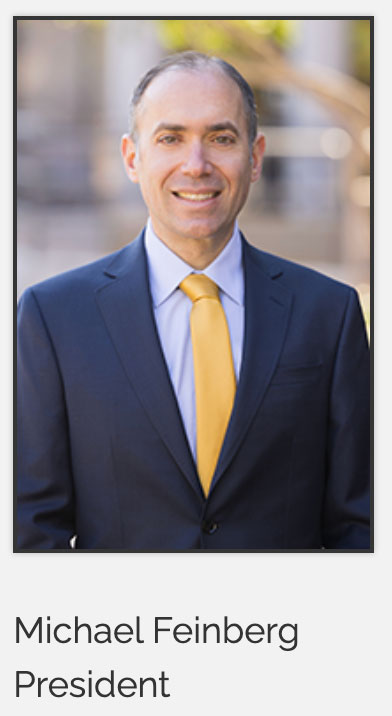
Leading with Inclusivity: Dr. Feinberg’s Vision for PCSO’s Future
When Dr. Michael Feinberg thinks about his role as PCSO President, one word keeps coming to mind: inclusivity.”I want people to feel that no matter what, as an orthodontist, this is where they belong,and they have something to contribute,” he says. “They should never feel intimidated by being part of their professional association.
It’s a philosophy that comes naturally to someone who found his own path to orthodontics through an open door policy, keeping all options on the table and following where his interests led him.
An Unexpected Journey
Dr. Feinberg’s route to orthodontics wasn’t exactly a straight line. Growing up in the San Fernando Valley as the son of a periodontist, he worked chairside in his father’s office during high school and went to UC Berkeley thinking he’d become a physician. “I never even had braces as a kid,” he laughs.
But something shifted during college. The premed crowd wasn’t quite his group of people, and he kept meeting dentists who seemed genuinely happy with their lives and careers. “Literally, every dentist was happy. They had a great schedule, very family conducive,” he recalls. Initially, his father tried to talk him out of dental school, insisting the landscape had changed, but Dr. Feinberg suspects his father just didn’t want to be responsible for the decision.
At UCSF dental school, he initially intended in pursuing oral surgery. Then a mentor, Dr. Jill Helms, encouraged him to do a rotation in the craniofacial anomalies clinic. “I loved seeing how orthodontics could impact these patients lives” he says. “I started to hang out in the ortho clinic and really just went from there. It was mostly just being open to what came my way, not closing any doors along the way.”
Looking back, he feels lucky the path found him. “I’ve always felt so fortunate that this was my journey.”
A Culture of Service
That sense of openness and following where opportunities lead has defined Dr. Feinberg’s career in organized orthodontics too. After residency at UCSF, his first position was with Jerry Nelson, Mike Myers, and Paul Kasrovi in Berkeley,CA. “What an incredible group,” he says. “They had a tradition of volunteerism.” Jerry served as AAO journal editor, Mike was involved with the World Federation of Orthodontists, and Paul was active locally and with the PCSO.
Two years later, when Dr. Feinberg moved to Arizona, his partner Bruce Goldstein was involved heavily with CDABO, eventually becoming President. “I kind of felt the same philosophy I did coming out of Berkeley. He’s got his thing, I want to have my own thing too.”
Dr. Feinberg worked his way through leadership roles in the Arizona State Orthodontic Association, then got the tap on the shoulder that he needed to go bigger. “Paul Kasrovi shows up at our state meeting one year and says, ‘You need to be on the board when I’m president of the PCSO.’ So I put my name in the hat.” He also joined the AAO PAC board around the same time, serving on both simultaneously for several years.
“I will tell you, the PCSO board experience is the best volunteer work I’ve ever had, and I’ve served on several boards,” he says. “The group is wonderful. They’re respectful, they’re hard-working. People take it very seriously, and we move the organization forward in a super positive way with good energy. As soon as I was off the board, I was like, okay, how do I get back in?”
Building on a Strong Foundation
Now serving as president, Dr. Feinberg is quick to acknowledge those who came before him. “The people who have come before me have left the association in such a great position that in many ways, my goal is to keep it moving along in the direction they’ve sent it.”
However, he’s also bringing his own priorities to the role. High on his list is fiscal responsibility and transparency. “I want to really make sure that PCSO is fiscally responsible, that we have transparency, and that we are spending our members’ dollars properly and with respect for why people have paid membership dues.”
Even more important to him is strengthening the connection between PCSO and its components. Years ago, Kurt Stormberg tasked him with heading up a component relations task force, which evolved into a committee with three subcommittees. “Really, the goal is to make sure that our components are functioning properly and that they can deliver services to our members directly,” he explains. “Some components are functioning really well and some really struggle, and I want to help make all components successful.”
At a recent board meeting in Hawaii, he led the board through an exercise exploring PCSO’s role in the tripartite system. His conclusion? “Our big role is to really enhance our components’ functioning, to really bring the PCSO to members in their state or province where they can feel like they are truly part of something rather than just feel like they have a membership in an association.”
The DSO Challenge
When asked about the biggest challenges facing orthodontics today, Dr. Feinberg doesn’t hesitate. “Keeping orthodontists engaged” tops his list. While AAO membership hovers at around 85% of all orthodontists, which is remarkable, the rise of DSOs presents both opportunities and challenges.
“As the corporate model becomes more part of our system, and they’re not going anywhere, it’s part of our industry now, how are we going to work with them in a way where they can understand the value of organized orthodontics?” he asks. “And how can we make sure that employed orthodontists, not just owner orthodontists, are able to be members?”
He points to a promising example from an advocacy conference several years ago in DC, where the AAO invited the chief legal officer from Pacific Dental Services. “He was not an orthodontist, but they invited him to the conference, and I was assigned to hit the Hill with him to lobby together for orthodontic focussed initiatives. I think that was a move in the right direction, but I haven’t seen that type of collaboration happen again.”
The key is building relationships based on collaboration and mutual respect. “That’s a big challenge, making sure that employed orthodontists don’t feel like they’re not part of something or respected in the same way. It’s tough to overcome those ideas, but I think that’s critical.”
He’s particularly focused on young orthodontists who often start their careers as employed doctors. “Those are very important growth periods,” he notes. PCSO has already made strides here, with recent presidents like Norm Nagel pushing for younger involvement. “We have a new and younger member sitting on our board, and we have many recent grads and even residents sitting on our committees. In many ways, the PCSO is ahead of the game with that.”
Advocacy: The Differentiator
Dr. Feinberg’s years on the AAO PAC board gave him deep appreciation for advocacy work. “That’s a passion of mine, to really make sure that advocacy is understood and felt by our members because it’s a unique benefit that only the AAO or an association can deliver to members that’s different than just going to a meeting or being in a study club. Advocacy is essential.”
His time on the PAC board also helped him build relationships with AAO trustees, “So many people are intimidated by them or think they’re not accessible, but everybody is accessible. We’re all people who straighten teeth every day.”
A Place at the Table
That accessibility, that sense that everyone belongs, threads through everything Dr. Feinberg hopes to accomplish as president. “I don’t want to mess it up,” he jokes about his legacy. “I want to be inclusive. I want people to feel comfortable being a part of this and make sure that they feel value in it.”
His wife is deeply involved in nonprofit management and volunteering. His partners have always been engaged in organized dentistry and orthodontics. And his own experience has shown him what volunteer work at this level can offer. “We are so lucky to be part of the BEST profession. It’s our responsibility to give back.”
With a little under two years left in his term on the executive committee, Dr. Feinberg is already thinking about what comes next, how to stay involved after his presidency ends. But for now, he’s focused on making sure every PCSO member, whether they’ve been practicing for decades or just finished residency, whether they own their practice or work for a DSO, knows they have a seat at the table.
“We owe a lot to the fact that we get to do this every day,” he says of the orthodontic profession. “That’s a big reason why people I know volunteer. And I just want everyone to feel like this is where they belong.”
Dr. Michael Feinberg practices in Arizona and is currently serving as President of the Pacific Coast Society of Orthodontists. He previously served on the AAO PAC board and has been active in component leadership for many years.